Maharashtra Lift Rules 2026: Society Safety & Deadline
Explore Maharashtra Lift Rules 2026, including monthly servicing, annual safety audits, CCTV, insurance and the October 2027 deadline for housing societies.
By HomesPro Editorial Team12 min read
Explore available properties
Properties you may want to explore
Choose a topic to explore matching projects. When no projects match, explore available properties below or view the full listing.
Maharashtra has introduced a strengthened regulatory framework for lifts, escalators and moving walkways, bringing important changes for residential housing societies, commercial buildings and property owners. The Maharashtra Lifts, Escalators and Moving Walks Rules, 2026 introduce stricter servicing, safety inspection, insurance and equipment requirements. For apartment residents in Mumbai, Pune, Thane, Navi Mumbai and other parts of the state, the changes make lift safety a more visible part of everyday building management.
The new framework took effect on 1 November 2026, following notifications issued by the Maharashtra Energy Department in October. Existing lift installations have a separate compliance timeline for specified safety upgrades, with 28 October 2027 identified as the deadline. HomesPro examines what these changes mean for housing society committees, flat owners, tenants, homebuyers and developers.
What Are the Maharashtra Lift Safety Rules 2026?
The Maharashtra Lifts, Escalators and Moving Walks Rules, 2026 establish requirements for installing, operating, inspecting and maintaining vertical transport equipment across the state. They operate under the Maharashtra Lifts, Escalators and Moving Walks Act, 2017, which was brought into force from 1 November 2026.
The objective is to move beyond maintenance carried out only when equipment breaks down. The framework places greater emphasis on regular inspections, documented servicing, safety devices and clearly assigned responsibility. The requirements extend beyond residential towers to applicable commercial and public buildings.
Swipe across to compare all columns →
Regulation
Requirement
Effective date
1 November 2026
Monthly servicing
At least once every month by an approved contractor
Annual safety audit
Required, with applicable reporting to the electrical inspector
Third-party insurance
Required for covered lift installations
CCTV
Required for new lifts and specified existing installations
Automatic Rescue Device
Safety equipment required under the applicable upgrade provisions
Overload Protection Device
Safety equipment required under the applicable upgrade provisions
Existing lift retrofit deadline
28 October 2027
Accident reporting
Within 24 hours to the electrical inspector and local police
Children below 12
Adult supervision required
1. Monthly Lift Servicing Is Mandatory
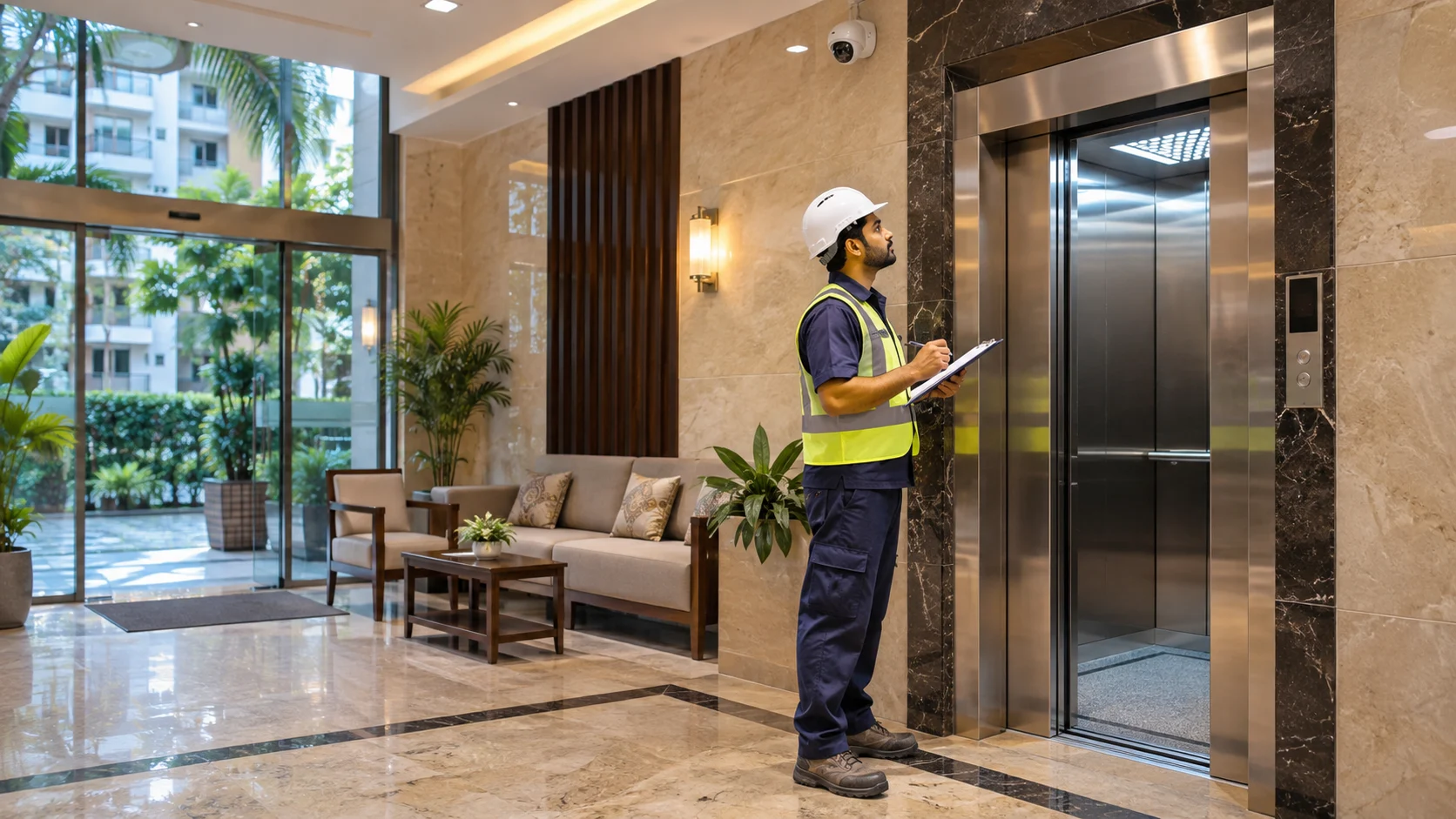
One of the most significant requirements concerns preventive maintenance. Lift owners or licence holders must arrange inspection and maintenance through approved contractors at least once a month. The servicing process should be documented in a logbook so that recurring faults, completed repairs and outstanding issues can be tracked.
For housing society management committees, merely signing an annual maintenance contract should not be treated as sufficient evidence that every required inspection has occurred. Committees should verify whether each monthly visit took place, what observations were recorded and whether defects were resolved.
Maintain a month-wise service schedule for every lift.
Verify the approval and credentials of the maintenance contractor.
Preserve inspection reports, service entries and repair records.
Track repeated complaints such as sudden stopping, door faults or unusual vibrations.
Confirm that critical safety defects are addressed before continued use.
Keep emergency contact information accessible to residents.
2. Annual Lift Safety Audits Become an Essential Compliance Check
The rules require periodic safety auditing and testing, with annual certification and reporting obligations. The audit process is intended to identify safety-related defects that might not become obvious during everyday use. Housing societies should coordinate with qualified and approved service professionals to understand the prescribed testing and certification requirements.
An annual audit is distinct from routine servicing. Monthly maintenance addresses ongoing equipment performance, while periodic safety testing provides a more structured examination of compliance and safety conditions. Both activities should be documented rather than assumed to have been completed.
3. CCTV, Rescue Devices and Overload Protection
The new safety framework specifically addresses three important systems: CCTV surveillance, Automatic Rescue Devices and Overload Protection Devices. These technologies serve different purposes, and residents should understand why their availability matters.
CCTV Cameras Inside Lifts
CCTV footage can assist building management in understanding incidents involving lift passengers, equipment or misuse. New lifts are required to incorporate CCTV, while existing installations must meet the applicable retrofit requirements. Societies should also establish appropriate footage access controls, retention practices and privacy safeguards.
Automatic Rescue Device (ARD)
An Automatic Rescue Device is designed to assist passengers when normal electrical power fails. In compatible installations, the device helps move the lift to a nearby landing and open the doors using backup power. Its presence can reduce the risk of passengers being stranded during certain power interruptions.
Overload Protection Device (OLPD)
An Overload Protection Device helps prevent a lift from operating when its permitted load capacity has been exceeded. This is especially relevant in busy residential towers, where passengers, luggage, delivery equipment and household items may create excessive loading.
Swipe across to compare all columns →
Safety System
Primary Function
Why It Matters
CCTV
Records lift activity
Supports incident review and building security
ARD
Provides automatic rescue functionality during certain power failures
Can reduce passenger entrapment
OLPD
Detects excessive loading
Helps prevent unsafe operation under overload conditions
4. October 2027 Deadline for Existing Housing Society Lifts
Existing installations that lack the specified CCTV, ARD or OLPD systems have been given a retrofit period ending on 28 October 2027. This deadline is particularly important for older residential buildings where lift equipment may have been installed before modern safety features became common.
The deadline should not be confused with the date on which the wider regulatory framework became operational. Monthly servicing, periodic inspection and other applicable obligations need attention independently of the retrofit timeline.
For an older housing society, the practical first step is to obtain a technical assessment. A qualified contractor can examine whether the existing installation can accommodate the required systems or whether more extensive modifications may be necessary.
5. Third-Party Insurance for Lift Installations
Third-party insurance is another significant element of the Maharashtra lift safety framework. The governing legislation requires owners to ensure insurance protection against specified risks to passengers using lift, escalator and moving walkway installations.
For cooperative housing societies, insurance should be treated as a distinct compliance item rather than automatically assuming that a general building insurance policy provides the required protection. Committees should confirm the policy's coverage, exclusions, insured installations, validity period and renewal arrangements with their insurer.
6. Stronger Enforcement and Accident Reporting
Electrical inspectors have powers under the applicable legislation to address unsafe lift installations, including directing corrective measures and discontinuation of use. Where statutory directions are not followed, an unsafe installation may face sealing under the prescribed procedure.
Accidents involving lifts, escalators or moving walkways must be reported to the relevant electrical inspector and local police within 24 hours. Building managers should therefore maintain a written emergency response protocol that identifies who will contact emergency services, the maintenance contractor and the appropriate authorities.
An installation that has remained non-operational for six months or longer cannot simply be switched back on for passenger use. Prescribed on-site testing by an approved contractor is required before restarting operations.
7. Special Safety Requirements for Children and Emergency Assistance
The rules include safety provisions relevant to families living in multistorey buildings. Children below 12 years of age are not permitted to use lifts or escalators without adult supervision. Lift operators must also meet the minimum age requirement of 18 years.
Approved maintenance contractors have emergency call-handling responsibilities, including round-the-clock complaint and emergency support. Housing societies should verify how their service provider receives emergency calls and how technicians are dispatched when a lift develops a fault.
Display safe-use instructions near lift entrances.
Ensure children below 12 use lifts with adult supervision.
Display the emergency contact number inside or near the lift.
Explain to residents why they must never force lift doors open.
Keep emergency access and service areas unobstructed.
Train security personnel in emergency escalation procedures without encouraging unauthorised rescue attempts.
8. How Much Will the New Lift Safety Requirements Cost?
The financial impact will vary between housing societies. A recently installed lift that already contains compatible safety systems may need fewer modifications than an older installation with outdated control equipment. Installation complexity, contractor assessment, equipment compatibility, audit requirements and insurance coverage can all affect expenditure.
There is no single reliable upgrade amount applicable to every housing society. A committee should compare detailed quotations for the same technical scope rather than selecting the lowest headline price. Any proposal should identify equipment, installation labour, testing, certification, taxes, warranties and ongoing maintenance responsibilities.
How Should Housing Societies Plan the Budget?
Obtain a condition report for each existing lift.
Identify which safety devices are already installed and functioning.
Request itemised quotations from suitable approved service providers.
Compare equipment specifications and warranty coverage.
Budget separately for annual audits, insurance and routine maintenance.
Discuss significant capital expenditure through the society's applicable approval process.
Maintain an appropriate contingency for unexpected technical work.
9. What Do the Rules Mean for Mumbai Homebuyers?
Lift safety is an important but sometimes overlooked part of residential property due diligence. Buyers typically compare carpet area, floor plans, parking, amenities, connectivity and society maintenance charges. The new Maharashtra framework provides an additional reason to examine how a building's lifts are maintained.
This is especially relevant when buying a resale apartment in an older tower or considering a high-floor residence where daily dependence on lifts is substantial. A well-maintained lift does not automatically establish overall building safety, but incomplete maintenance records or unresolved defects may justify further technical enquiries.
Lift Safety Checklist Before Buying a Resale Flat
Ask the society about the age and type of installed lifts.
Check whether a current lift licence and inspection records are available.
Ask when the most recent maintenance visit and safety audit were completed.
Verify the availability of CCTV, ARD and overload protection.
Check whether the society has scheduled any necessary upgrades.
Review lift-related complaints and major repair history where records are available.
Ask whether planned upgrades may affect future maintenance contributions.
Assess lift availability, waiting times and backup arrangements during the site visit.
For homebuyers comparing residential developments in Mumbai, lift compliance should be reviewed alongside legal documentation, structural condition, building approvals and other safety systems. HomesPro recommends looking at the complete ownership experience rather than evaluating a property only by its interiors or advertised amenities.
10. What Should Developers of New Residential Projects Check?
Developers planning new residential buildings should coordinate lift specifications, safety systems, installation permissions, testing and licensing with their technical consultants and approved contractors. Incorporating the requirements at the design and procurement stage may help reduce avoidable modifications later.
For under-construction projects, buyers can ask developers about planned lift capacity, emergency rescue arrangements, power backup, fire and evacuation planning, proposed maintenance responsibility and the applicable commissioning approvals. These checks complement, rather than replace, verification of project approvals and MahaRERA information.
Explore Under-Construction Properties in Mumbai
Compare residential projects across Mumbai and MMR, including configurations, locations, amenities and possession details.
11. Lift Safety During Housing Society Redevelopment
Societies considering redevelopment should treat lift safety as part of the technical planning process. The proposed building's lift capacity, number of elevators, accessibility provisions, emergency systems, maintenance arrangements and long-term replacement costs deserve attention before project specifications are finalised.
The 2026 lift regulations and the separate Maharashtra housing society redevelopment procedure address different matters. One concerns lift safety and operation, while the other governs aspects of society redevelopment decisions. Neither should be confused with a guarantee of construction completion, automatic approval of a proposed development or a substitute for independent technical assessment.
Understand Maharashtra Redevelopment Rules 2026
Read HomesPro's detailed guide covering society approvals, developer selection, member rights, documentation and redevelopment timelines.
Housing society committees can use a structured compliance review to identify the most urgent issues. The following timeline is a HomesPro editorial recommendation for organising work; it is not an additional statutory timetable.
Swipe across to compare all columns →
Suggested Stage
Recommended Society Action
Immediately
Review lift licences, insurance, maintenance contracts and inspection records.
Within 30 days
Arrange a professional review of existing safety systems and known defects.
Within 60 days
Obtain itemised quotations for missing safety devices and required technical work.
During budget planning
Approve expenditure through the appropriate society process and schedule implementation.
Before 28 October 2027
Complete applicable safety retrofits, testing and documentation.
Every month
Verify servicing records and follow up on unresolved defects.
Every year
Complete the applicable audit, certification and insurance reviews.
Frequently Asked Questions About Maharashtra Lift Rules 2026
1. When did Maharashtra's new lift safety rules come into effect?
The new regulatory framework became effective on 1 November 2026. The commencement notification was issued by the Maharashtra Energy Department in October 2026.
2. Is monthly lift servicing compulsory in housing societies?
Yes. The rules require covered installations to undergo inspection and maintenance at least once a month through an approved contractor, with appropriate service records.
3. What is the deadline for installing CCTV and other safety devices?
Existing lifts covered by the retrofit provisions have until 28 October 2027 to install the specified CCTV, Automatic Rescue Device and Overload Protection Device systems.
4. Does every old lift need to be replaced?
The safety-device requirements do not by themselves establish a universal requirement to replace every older lift. The necessary work depends on technical condition, compatibility and applicable compliance standards. A qualified assessment is essential.
5. Is third-party insurance compulsory for residential lifts?
Yes. The governing legal framework includes third-party insurance obligations. Owners and housing societies should verify that the applicable installation has appropriate and valid coverage.
6. Can children use residential lifts without supervision?
Children below 12 years of age must have adult supervision when using lifts or escalators under the new safety provisions.
7. What happens if a housing society operates an unsafe lift?
Electrical inspectors have statutory powers to direct corrective measures and discontinue unsafe operation. Installations may also be sealed under the applicable procedure when compliance directions are not followed.
8. Are the new requirements limited to Mumbai?
No. The Maharashtra framework applies across the state to covered installations, including those in residential, commercial and public buildings. Applicability should be assessed according to the installation and relevant legal provisions.
9. Who is responsible for arranging lift maintenance?
Owners and licence holders have responsibilities under the governing framework. In a cooperative housing society, the management committee should coordinate compliance, maintain records and engage suitable approved contractors in accordance with the applicable arrangements.
10. Should homebuyers check lift maintenance before purchasing a flat?
Yes. Reviewing lift condition, maintenance records, inspection documentation and planned upgrade expenses can help buyers understand building management quality and potential ownership costs, particularly when evaluating resale apartments.
HomesPro Editorial Conclusion
Maharashtra's updated lift safety framework makes routine maintenance, documented inspections and essential protection systems more important for building owners and housing societies. The transition also creates a practical opportunity for societies to review equipment condition, assess long-term expenditure and improve their emergency procedures.
For residents, safer lift operation depends on more than the presence of modern equipment. Timely maintenance, competent contractors, responsible building management and awareness among passengers remain essential. For prospective buyers, the condition and upkeep of common facilities should form part of a broader property due-diligence process.
A residential building should be evaluated not only by the apartment behind its front door, but also by the safety and reliability of the shared infrastructure residents depend on every day.
Looking for a Home in Mumbai?
Explore residential projects, ready-to-move homes and resale property options across Mumbai and MMR with HomesPro.
Primary legal references: Maharashtra Lifts, Escalators and Moving Walks Act, 2017; Government of Maharashtra Energy Department notification No. CEI-2026/CR-135/ENR-1 dated 22 October 2026; and Maharashtra Lifts, Escalators and Moving Walks Rules, 2026, notified on 28 October 2026. The commencement notification is available in the Maharashtra Government Gazette dated 22 October 2026.
Additional reporting reviewed: Hindustan Times, 9 November 2026; Times of India, 14 November 2026; and Mirror Now, 14 November 2026. The HomesPro recommendations concerning buyer due diligence, budget preparation and committee planning are independent editorial guidance, not additional statutory requirements.
Editorial and Legal Disclaimer
This article was prepared by the HomesPro Editorial Team using information available as of 14 November 2026. It is intended for general real estate education and does not constitute legal, engineering, insurance or regulatory advice. Requirements may vary according to the type of installation, licensing position and subsequent official notifications. Housing societies and property owners should consult approved technical professionals and the appropriate electrical authority before making compliance decisions.
Have a question about this article or a property?
Buyer note
Always verify MahaRERA details, title documents, approvals, and total ownership costs before booking a property.